
How to Pack Artwork for Moving Safely
Learning how to pack artwork for moving starts with identifying the object—not applying the same paper, plastic, bubble cushioning, or box to every piece. A framed print under glass, an exposed canvas, an unframed photograph, a heavy mirror, and a sculpture have different surfaces, weak points, weights, and handling risks.
This guide explains how to document condition, inspect frames and surfaces, select a household picture-box plan, protect glazing and corners, prepare paper-based art and sculpture, plan stairs and storage, and recognize when a conservator, custom crate, or specialty art carrier may be appropriate.
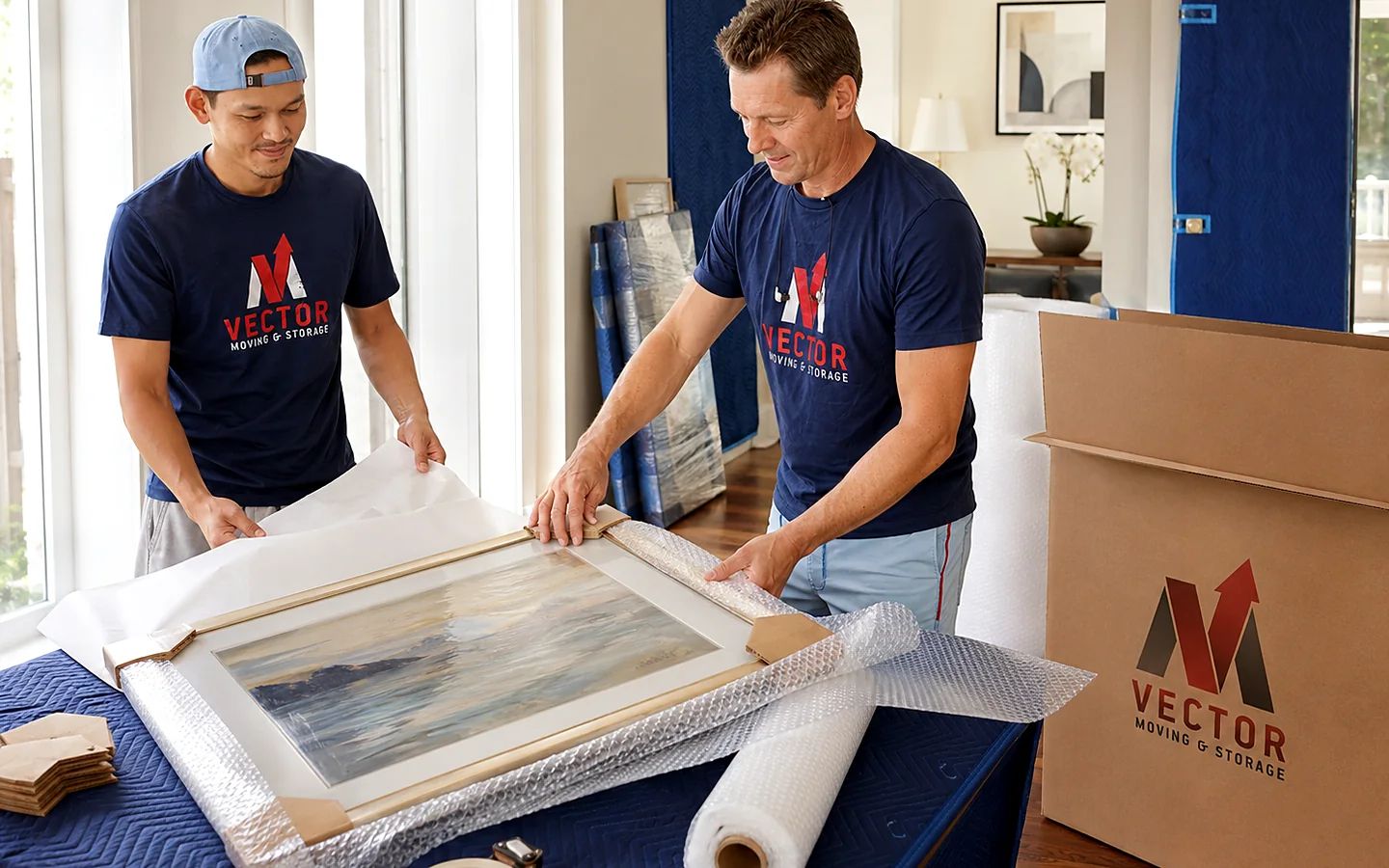
Ordinary Framed Décor and Significant Artwork Need Different Plans
Professional household packing may be suitable for many decorative pictures, framed prints, ordinary mirrors, and stable household artwork. Valuable, historic, unusually fragile, oversized, unstable, lender-controlled, gallery-owned, or environmentally sensitive work may need a conservator, specialty art packer, custom crate, or fine-art transportation provider.
Standard Household Picture-Box Plan
Often appropriate for stable framed décor with sound frames, manageable size, ordinary household value, and no active surface or glazing problem.
Detailed Packing Review
Useful for large frames, glass or acrylic glazing, sentimental pieces, multiple artworks, stairs, long-distance moves, storage, or uncertain construction.
Specialist or Custom-Crate Review
Consider for unstable paint, fragile antique frames, oversized glass, sculpture, valuable collections, gallery requirements, mixed media, stone, or unusual environmental needs.
Artwork Packing Planner
The planner gives a cautious starting direction. It does not certify an artwork as fit for travel, choose conservation materials, guarantee mover eligibility, or replace an in-person specialist review.
Suggested Planning Direction
Detailed household-art packing reviewReview the frame, glazing, dimensions, route, rigid face protection, picture carton, cushioning, labels, and delivery placement before packing begins.
Photograph the Artwork Before It Leaves the Wall
A condition record helps distinguish pre-existing wear from a change discovered after packing, transit, storage, or delivery. Record each artwork separately instead of placing an entire collection under one vague description.
Minimum Condition Record
Front: complete image plus close-ups of any existing marks.
Back: backing, labels, stretcher, hanging wire and hardware.
Frame: every corner, joint, decorative element and prior repair.
Identification: dimensions, artist or title when known, room, destination and package number.
After delivery: repeat the photographs before packaging is discarded.
Loose Frames and Unstable Surfaces Should Be Addressed Before Transit
A visually ordinary picture can contain weak frame joints, loose glazing, unstable hanging wire, torn backing, canvas movement, flaking paint, protruding fasteners, or previous repairs. Handling can make those problems worse.
Frame and Glazing
Check frame corners, decorative elements, backing, glazing movement, loose points, hanging wire, D-rings, and sharp or protruding hardware.
Painted Surface
Look for flaking, tackiness, cracks, lifted areas, abrasion, deformation, tears, loose keys, or a canvas that moves excessively in the frame.
Paper and Photographs
Check for tears, folds, cockling, brittle edges, loose hinges, moisture, surface media, and contact with glazing or acidic backing.
Three-Dimensional Objects
Identify the base, center of gravity, removable components, weak joins, fragile projections, unstable finishes, and safe lifting points.
When the surface is flaking, sticky, powdery, cracked, detached, water-damaged, mold-affected, or otherwise unstable, pause ordinary packing and seek qualified conservation or specialty guidance.
There Is No Universal Direct-Contact Layer for Every Artwork
The purpose of packaging is to support the object, prevent contact and movement, protect weak edges and surfaces, and provide an outer container suitable for the handling network. The correct contact layer depends on the medium and condition.
| Material or Component | Possible Purpose | Important Limitation |
|---|---|---|
| Picture or mirror carton | Outer enclosure for framed art and selected mirrors | Must be properly sized and cushioned; an empty box alone does not immobilize the item. |
| Corner protectors | Reduce direct impact on frame corners | Should not press on loose ornament, glazing, or a vulnerable surface. |
| Rigid cardboard or foam board | Face, back, or flat support | Must not touch exposed paint or create pressure in the center. |
| Clean paper or suitable interleaving | Separate stable surfaces and prevent abrasion | Glassine, tissue, plastic, and other layers are not universally suitable for every medium. |
| Bubble cushioning or foam | Secondary cushioning around protected artwork | Do not press bubbles or foam directly against tacky, friable, textured, or vulnerable art surfaces. |
| Moving blankets | Outer padding for selected framed pieces or crates | Blankets should not rub against exposed artwork or become the only enclosure for fragile glazing. |
| Packing tape and stretch film | Close outer packaging and hold protective assemblies | Keep adhesive away from artwork and finished frame surfaces. |
| Custom crate or specialty enclosure | Support, block, cushion, and protect selected objects | Design depends on object weight, weak points, handling hazards, route, and environmental requirements. |
Use a Different Method for Frames, Canvases, Paper, Mirrors and Sculpture
Framed Artwork Under Glass or Acrylic
Measure the complete frame, not only the visible image. Protect vulnerable corners and edges, provide rigid face protection without pressure on the center, and use a properly sized picture or mirror carton with enough cushioning to prevent movement.
- Inspect glazing, frame joints, backing, and hanging hardware first.
- Keep tape and adhesive away from the frame and glazing surface.
- Do not place several heavy glazed frames loose in one ordinary carton.
- Fill voids so the frame cannot slide, rotate, or collide with the box wall.
- Label the front, back, orientation, destination room, and carton number.
Canvas Paintings and Exposed Painted Surfaces
Prevent pressure, abrasion, and loose packaging from touching a vulnerable paint surface. A stable framed canvas may use an appropriate barrier and rigid outer protection, but textured, flaking, tacky, recently painted, encaustic, pastel, mixed-media, or otherwise sensitive work needs specialist review.
- Do not place bubble cushioning directly against exposed paint as a universal method.
- Use a handling or travel frame when the work needs separation from outer wrapping.
- Protect the reverse from puncture and loose hardware.
- Provide a stable receiving area before unpacking.
Unframed Prints, Photographs and Works on Paper
Keep paper-based work flat on clean rigid support and protect it from bending, moisture, dirt, pressure, and direct adhesive contact. Do not roll a work merely because it is on paper unless an artist, conservator, or appropriate specialist confirms rolling is suitable.
- Use clean rigid boards larger than the work.
- Prevent shifting inside the folder or enclosure.
- Keep pressure-sensitive tape away from the paper.
- Separate works so media and surfaces do not rub.
Mirrors and Oversized Glazed Frames
Review glass, backing, frame construction, dimensions, weight, stair route, elevator, doors, truck position, and destination placement. A mirror may need a multi-piece carton, rigid protection, edge support, a crate, or specialist handling depending on size and construction.
- Measure the narrowest turn, not only the front door.
- Do not use the mirror as support for other boxes or furniture.
- Identify glass, frame, and backing weaknesses before lifting.
- Plan how the item will rest safely before and after carrying.
Sculptures and Three-Dimensional Artwork
Support the stable base and prevent pressure on projecting or fragile components. The enclosure should control movement without deforming the object or transferring shock through its weakest parts.
- Identify the center of gravity and approved lifting points.
- Remove detachable parts only when the construction and documentation support it.
- Use custom blocking, foam, an inner box, or a crate when appropriate.
- Do not tightly wrap protrusions simply to make the sculpture fit a carton.
- Label orientation and the side used for opening.
Mixed-Media, Textile, Stone, Glass or Unusual Artwork
Mixed materials may react differently to contact, pressure, vibration, temperature, humidity, and packing products. Stone and glass may be heavy and brittle; textile and mixed-media surfaces may snag, shed, deform, or contain loose elements.
Send photographs, dimensions, materials, weight, condition, and installation details before booking. A specialty provider may be required even when the object is located in an ordinary home or office.
A Crate Is an Engineered Packing Decision—not Just a Wooden Box
Some artwork may require custom crating, a travel frame, fitted blocking, specialty cushioning, or a qualified fine-art provider. Availability, design, materials, handling, transportation, storage, and cost must be reviewed before the moving date.
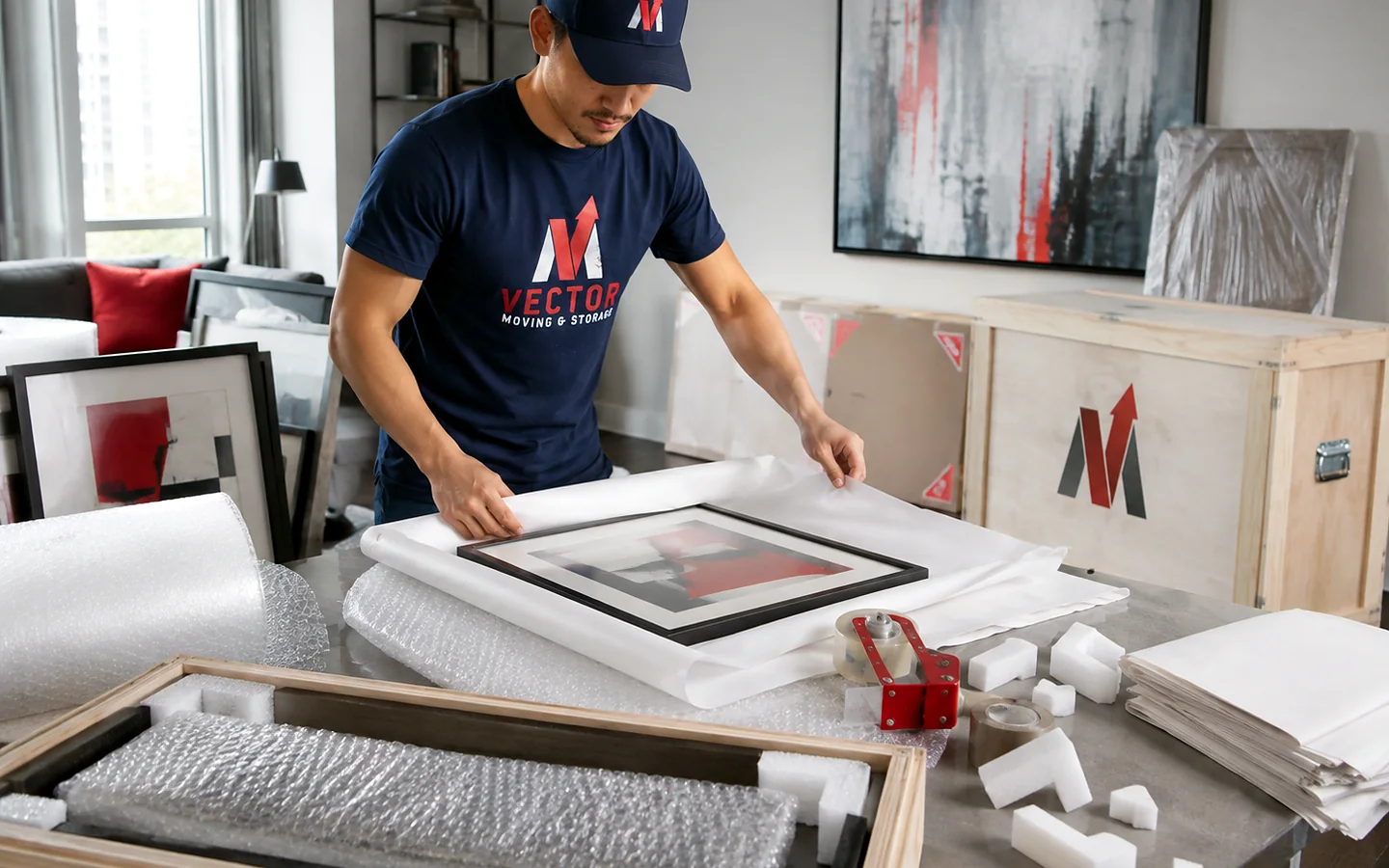
Plan the Artwork’s Complete Path Before It Is Packed
Pickup Route
Measure doors, hallways, landings, stairs, elevator openings, ceilings, turns, and the distance to the lawful truck position.
Truck Loading
Keep packed artwork stable and protected from shifting, puncture, crushing, heavy furniture, and loose tools or hardware.
Transit and Storage
Disclose environmental sensitivity. Do not assume ordinary trucks or warehouses provide controlled temperature or humidity unless confirmed in writing.
Delivery and Receiving Area
Prepare a clean, padded, stable place for the packed work before unwrapping, placement, or installation begins.
Orientation depends on the piece, package, and specialist instructions. Do not publish or follow a universal rule that every painting, mirror, or sculpture must travel flat or upright.
Artwork Going Into Storage Needs an Inventory and Retrieval Plan
Artwork should be assigned an inventory number, package or crate number, destination room, storage status, and delivery priority. Separate anything that may be required before the complete shipment leaves storage.
Vector warehouse storage is not routine walk-in self-storage. Access, vault positioning, retrieval, return to storage, or separate delivery should be scheduled under the written storage agreement.
Environmental Sensitivity
Temperature, humidity, condensation, water, shock, vibration, and extended handling can affect certain paintings, photographs, paper, wood, textiles, adhesives, mixed media, and finishes.
Use written confirmation: do not assume “climate-controlled” transportation or storage is included. Disclose the artwork’s requirements before the quote.
Review the Actual Moving Documents Before Transporting Valuable Art
Mover valuation and separate third-party insurance are not automatically the same thing. California and interstate moves may use different terminology, forms, and rules.
California Moves
Review the protection option and value selected in the California moving agreement and current BHGS consumer information. Keep appraisals and condition records with the moving file.
California household-mover information →Interstate Moves
FMCSA distinguishes Full Value Protection from Released Value. Interstate articles valued above $100 per pound may be treated as extraordinary-value items and should be disclosed in the shipping documents.
FMCSA valuation information →Appraisals and Documentation
Keep current appraisals, purchase records, provenance, serial numbers, photographs, artist information, and condition reports outside the shipment.
Interactive Artwork Packing Checklist
The checklist runs only in the browser and does not submit information to Vector Moving and Storage.
Check Condition Before Packaging Is Discarded
Move the package to a clean prepared receiving area, confirm orientation and opening instructions, and remove the outer materials without cutting toward the artwork. Compare the artwork with the pre-move photographs and condition record.
Hanging and installation are separate from transportation. Valuable, heavy, masonry-mounted, high-wall, gallery, or specialty installations may require property authorization and a qualified art installer.
Connect the Artwork Plan to Packing, Access, Storage and Delivery
Packing Services
Arrange full or partial packing and disclose artwork, mirrors, glass, antiques, stone, and custom items before the quote.
Professional packing services →Room-by-Room Packing Guide
Plan boxes, labels, first-night items, furniture hardware, storage, and the final 48 hours.
How to pack for a move →Kitchen and Fragile Items
Use detailed methods for dishes, glassware, ceramics, small appliances, and fragile household contents.
Packing kitchen and fragile items →Moving Box Calculator
Estimate standard, picture, mirror, dish-pack, wardrobe, and other moving cartons.
Moving box calculator →Long-Distance Moving
Review inventory, documents, valuation, packing, pickup, storage, and destination planning.
Long-distance moving services →Request a Quote
Send photographs, dimensions, condition, route, packing needs, storage, and specialty-item details before booking.
Request an artwork-packing review →Frequently Asked Questions
How do I pack artwork for moving?
Can bubble wrap touch a canvas painting?
Should paintings be transported flat or upright?
How do I pack framed art under glass?
How do I pack a mirror for moving?
What size picture box do I need?
Can several paintings go in one box?
How do I pack unframed prints or photographs?
How do I move a sculpture?
When does artwork need custom crating?
Can ordinary movers transport valuable artwork?
Should artwork be appraised before moving?
Is mover valuation the same as insurance?
Can artwork be placed in warehouse storage?
Is climate-controlled transportation available?
What should I inspect after delivery?
Will movers hang artwork at the destination?
Send Photographs, Dimensions and Condition Information Before Moving Day
Tell Vector Moving and Storage about the artwork type, frame, glazing, dimensions, weight, condition, value or significance, stairs, elevators, carrying route, local or long-distance destination, storage, and any custom-crate or specialist requirements. The office can explain which services are available and when another provider may be appropriate.








No comment